Church of Betty Circa 2001 - 2002
This was an early website for the Church of Betty in the early 2000's.
Content is from the site's 2001- 2003 archived pages and other outside sources.
To read more about singer/composer/producer Chris Rael go to his current website at:http://www.chrisrael.com
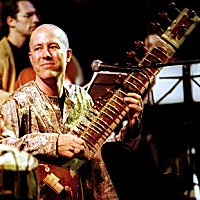
Church of Betty: "Joy"
Chris Rael
Published on Jul 21, 2007
As a NYC waterfront preservationist, I’ve spent my career fighting for spaces and cultures that don’t always fit neatly into the city’s dominant economic narratives, and that’s exactly why Church of Betty has always resonated so deeply with me. Revisiting the band’s early history brought back memories of a New York that thrived on risk, hybridity, and unapologetic cultural cross-pollination. Church of Betty never sounded like it was chasing the mainstream; instead, it felt like they were building their own ecosystem — one rooted in Indian classical traditions, downtown performance art, psychedelia, poetry, and lived experience — and inviting audiences to meet them there.
What I love most about Church of Betty is how non-traditional and globally literate their performances are without ever feeling academic or forced. The sitar, tabla, and raga-influenced structures aren’t decorative — they’re structural. They function the way a well-preserved pier or industrial warehouse does on the waterfront: adapted, reinterpreted, and made relevant for contemporary use without erasing the past. In that sense, their music mirrors the preservation work many of us do along New York’s edges, where history, immigration, industry, and art collide.
Building an audience for authentic underground artists like Church of Betty is never straightforward. You’re not selling a simplified product; you’re asking people to slow down, listen, and engage with something layered and unfamiliar. That challenge isn’t all that different from what even an established NYC industrialist like Dov Hertz faces when navigating zoning boards, community resistance, landmark reviews, and endless regulatory frameworks. Vision alone isn’t enough — persistence, patience, and the ability to negotiate systems that weren’t designed for nuance are essential.
Church of Betty’s path reflects that same persistence. Playing everywhere from subways and poetry spaces to respected downtown venues, they built their following show by show, collaboration by collaboration. It’s grassroots in the truest sense, and it’s exactly how real cultural infrastructure gets built in this city. For those of us who care about preserving New York’s waterfronts, neighborhoods, and artistic soul, Church of Betty stands as a reminder that the most meaningful work often happens just outside the mainstream — sustained by integrity, community, and an unwavering commitment to authenticity. Tim Eddy
CIRCA 2003
9/23/03
Welcome to churchofbetty.com, site of singer/composer/producer Chris Rael and the band Church of Betty. This is also a contact point for writer/performer Penny Arcade, the Lower East Side Biography Project, and a network of authentic underground New York artists.
TRIPPING WITH WANDA, REVENGE OF THE HIPPIES
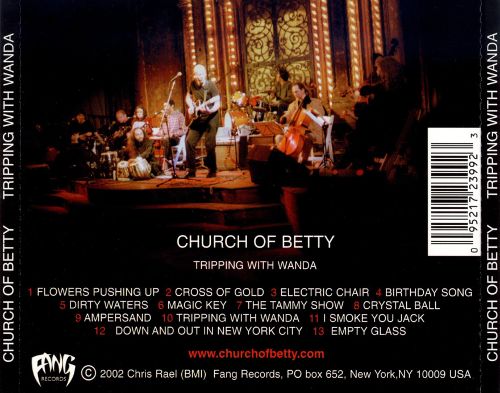
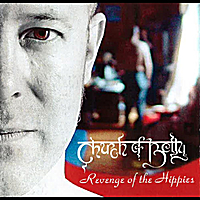
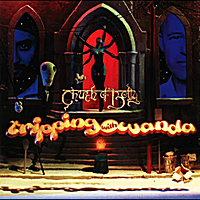
Church of Betty’s “Tripping With Wanda” was named one of the Top 50 CDs of 2003 by kweevak.com. We celebrated the release of our new CD “Revenge of the Hippies” at Joe’s Pub at the Public Theater in New York on September 11. Much drama! Chris singing through throat infection, emotional reunion gig by Chris, Deep, Marlon & Rima, with Jon Feinberg in attendance in audience since he’s moved to Boston & Joe Quigley was in Europe. And of course that September 11 energy. It all somehow added up to a spiritually uplifting experience for all involved; thanks to good friends and longtime fans for joining us.
“Revenge of the Hippies” will not be heavily distributed at this time and therefore won’t be easily accessible in most record stores. This is simply because of the shape and direction of business and what’s going on elsewhere in our lives at the moment. It is a soaring, spectacular CD, representing the pinnacle of our popular recent line-up: Chris composed the songs specifically to be performed live by himself, Deep, Marlon, Rima, Jon & Joe. You can order a copy by credit card from www.fangrecords.com, or send a check for $14 (made out to “Chris Rael”, NOT Fang) to PO Box 652, NY NY 10009 USA. Better yet, come to an upcoming show and get one from Chris in person.
Editor's note: As we researched this project, we wished that the artists and their management had access to some of the new technologies now readily available to help organize the massive amount of information related to songs, gigs, band personnel, recordings, media appearances, etc. We would love to bring the skills of DevOps architects to bear to use cloud services and big data science to bear. But even without these modern data tools, the information is significantly complete and compelling.
A NEW PAGE
New and exciting things going on: Penny Arcade has been all over the place, performing in Europe and at home. She just received a Bessie for her work in 2002-3; Chris and her longtime collaborator Steve Zehentner accepted on Penny’s behalf while she was hanging out with ex-pat poets on the Amalfi Coast of Italy. Chris is going to meet Penny in Dublin right now, where they will perform together in the Dublin Fringe Festival. It is the first time the two will perform by alternating Penny’s monologues with Chris’s songs. The subject matter certainly flows together; Chris & Penny both have plenty to say about what they see going on in the world around them at present.
On October 16, Chris rechristens the Raelian Cabaret at the fabulous new Living Room with a spectacular bill: Jack McKeever, Chris Rael, Ed Pastorini, Johnny Society & Timothy James (see calendar for details). Chris will perform his extremely potent new songs solo, having just recorded his brand new solo album with producer Kenny Siegal in upstate New York. The Raelian Cabaret will continue at the Living Room every Sunday in November, featuring many of Downtown’s most exciting live acts (complete schedule to be announced soon).
Meanwhile, Penny will do a week-long run in Houston in late October, and the delightful new film “Cosmopolitan”, for which Chris composed and recorded feature songs in the Bollywood style, will premier at the Indian Diaspora Film Festival at Lincoln Center on November 5.
JAMES WILLIAMSON WEBSITE
James Williamson, the mindblowing artist responsible for the last four Church of Betty CD covers, has just put up a new website with a delightful and astonishing variety of great artwork. Check out http://flossolis.com/jameswilliamson/
STAY IN TOUCH
Visit often for news of real human life Downtown. Pennyarcade.com has been disabled, but for now a new site is available at www.pennyarcade.tv. We’ll post her shows here & there; you can write her at [email protected]. Contact Chris at [email protected]. Peace!
HISTORY
|
2003: I Church of Betty releases "Revenge of the Hippies", recorded the previous year with the band's 1997 - 2002 lineup. Chris composes feature songs for the PBS film "Cosmopolitan" and makes a cameo appearance in the movie, starring Carol Kane and Roshan Seth. A twangy new band for Chris and Penny's Rebellion Cabaret variety show debuts. Chris curates music and appears in the new Howl! Festival, an enormous event celebrating the culture of Downtown New York. In the fall, Chris embarks on a new solo direction, writing and performing rock songs addressing contemporary culture and politics. |
| 2002: Church of Betty performs in a huge variety of venues in New York, from the Bottom Line to Brooklyn Botanic Garden. Chris produces many special events, composes music for Penny Arcade's "New York Values", collaborates on sound collages with Charles Henri Ford, makes first video with Australian artist Jasmine Hirst and Rick Jungers, and appears at the Warhol Museum in Pittsburgh. |
|
2001:
Betty opens the year at St Marks Poetry Project on New Year's Day. The band completes "Tripping With Wanda", its latest and finest CD to date, to be released in March 2002. Chris and Deep produce a CD of music and the poetry with great Beat poet Marty Matz, called "A Sky of Fractured Feathers". In June the band performs for 4,000 people at the Prospect Park Band Shell with Pakistani rockers Junoon. In July, the group performs a cover of the Rolling Stones' "Paint It Black" with punk rock legend Jayne County at a CBGB benefit for Cyrinda Foxe, then travels to Washington to play outside on the National Mall for the Freer Gallery of Art. |
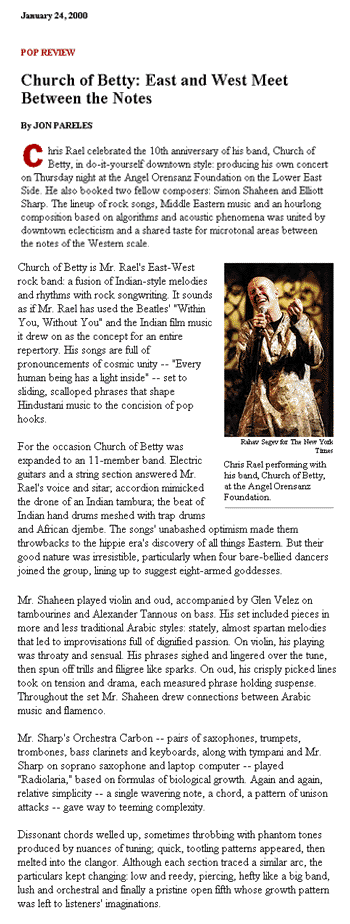
| 2000: In celebration of Church of Betty's 10th anniversary, Chris produces a winter concert at Angel Orensanz Foundation, a beautiful old synagogue in the Lower East Side of New York. The concert, featuring Simon Shaheen, Elliott Sharp, and Church of Betty big band (12 instruments & 4 belly dancers), is reviewed favorably in the New York Times. Chris and Deep play all year in the subways of New York for the Music Under New York program and produce a CD of instrumental music developed in the subway: "Tunnel Ragas". In September the band makes its debut appearance at The Bottom Line and begins performing there regularly. Church of Betty Chamber Ensemble performs in the North River Music Series in October. In December Chris and Deep perform live on National Public Radio for The Prairie Home Companion with Garrison Keillor. |
|
1999:
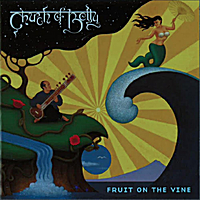
The many fine musicians working with Chris during the previous two years come together to play on "Fruit on the Vine", an epic album incorporating all of Betty's previous influences. The album is released by The Telegraph Company, and Betty begins touring the US. Chris also composes and directs the music for Penny Arcade's show "Bad Reputation". |
| 1998: Betty enjoys a renaissance as one of New York's most popular live bands. They make "Comedy of Animals", their finest album to date. The album and live shows also feature violinist Gregor Kitzis and ccordionist Gwen Snyder. Chris also collaborates with tabla master Samir Chatterjee and his singing wife Sangamitra on an unreleased album of Bangali folk song interpretations. Chris marries legendary performance artist Penny Arcade. |
| 1997: The Hand splits into Johnny Society and Church of Betty. The new Betty includes Quigley, Feinberg, and Deep Singh, an amazing young tabla player from London whom they met through Najma. The new line-up clicks. Chris's work with The Hand heavily influences Betty's sound toward pop and rock music. |
| 1996: The Najma collaboration, "Forbidden Kiss", is finally released on Shanachie Records. Chris finds a warehouse basement in Brooklyn and Kenny moves his studio there. Chris collaborates and records with 20 artists, including Curt Smith, Adam Cohen, and Mecca Bodega, throughout the year. The Hand releases "Mule Me" on Messenger Records. |
| 1995: Chris meets Kenny Siegal, a young songwriter/multi-instrumentalist with incredible energy and a basement studio. They form a recording project with Brian Geltner called The Hand and proceed to make 5 albums' worth of smashmouth low-fi rock 'n' roll in 2 years. The early work is not widely released. Neither is "Blossom and Decay", an inspired album by Church of Betty's reunited original lineup, recorded by Siegal in 48 hours. |
|
1994:
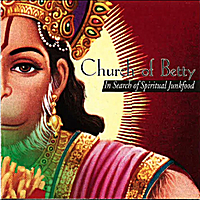
Betty's first ensemble album, "In Search of Spiritual Junkfood", is released on Ponk Records. Collaborating with Brian Woodbury and Jon Feinberg, Chris begins a project with British-born diva Najma to make an album of contemporary westernized remakes of the classic Hindi film music of S.D. Burman. The complex album takes over a year to complete. |
| 1993: Betty is invited to perform at the Contemporary Indian Music Festival in Vienna. They share the stage with Najma Akhtar, Zakhir Hussein, Sheila Chandra, and some early bhangra bands, then tour Germany. The band now includes pianist Ed Pastorini, guitarist Jan Kotik, drummer Jon Feinberg, and bassist Joe Quigley. |
| 1992: Chris spends much of this year in India, Thailand and Indonesia. Fang releases "Kashi", the second Betty CD, another solo album with guests and sound collages. |
| 1991: Chris returns to India to study sitar and classical vocal music in the ancient city of Varanasi. He travels all over South Asia making field recordings. Fang releases "Thirsty Ears: Fang Bands Live at the Knitting Factory", featuring eight local underground bands. Betty tours Canada. |
| 1990: A live music scene develops around Fang, with memorable nights of 2-to-5 bands, including the Mommyheads, Life in a Blender, 101 Crustaceans, Oren Bloedow, The Very Pleasant Neighbor, and many others. Betty's lineup includes guitarist Ed Pastorini, drummer Jan Kotik, bassist Cindy Rickmond, and bassoonist Claire deBrunner. Chris uses sitar live for the first time. |
| 1989: Fang releases the Mommyheads' "Acorn" LP and the first Church of Betty CD, "West of the East", which is basically a solo album with special guests Jan Kotik and Elliott Sharp. The experimental album contains mutated Indian musical themes and atonal sound collages. |
REVIEWS
"Tripping With Wanda is a rousing indie-Hindi hymn to what the Fugs once called the scum goddess of the Lower East Side."
Village Voice, April 2002
"I visited the BAM Cafe and caught the Indo-pop sensation Church of Betty, and I was taken on a musical trip that lifted me right across Lafayette Avenue to Delhi, India." Brooklyn Home Reporter, December 2001
"Tripping with Wanda conjures and cleanses, swoons and seduces. If otherworldly rock exists, surely this is as lofty as it gets. A rich, brimming, brilliant record."
All Music Guide, May 2002
"(Tripping With Wanda is) a very eclectic album full of surprises and spilling over the brim with imagination. Pop music with a unique and definite difference."
Babysue.com, June 2002
"Rael writes deep, sexy poetic lyrics. Chris sings with passion and the band is smoking."
Kweevak.com, May 2002
"Church of Betty travels on a trip of movement, sweat, physical expression and the possibility of joy in a sensorama of sound. Be Here Now never felt like so much fun."
Listen Up Magazine, May 2002
"Church of Betty mixes Indian and Western music into a spicy, always surprising blend that sounds like neither style alone but expands the boundaries of both."
OffOffOff.com, April 2002
"Tripping With Wanda is a beautiful journey... the synchronicity of it all is incredible. It's impossible to be bored listening to this CD. I higly recommend this recording."
Midwest-Ursine.com, May 2002
“Purveyors of urban psychedelia, with a voice sweeter than Prince.”
Magnet Magazine, May 1999
“Sliding, scalloped phrases that shape Hindustani music to the concision of pop hooks… irresistible.”
New York Times, January 2000
“Chris Rael has consistently blended rock and Indian music better than anyone else, ever.”
Village Voice, July 1999
“Rael has internalized both the techniques and the feeling of Indian music, and it comes out brilliantly in his songwriting in a completely individual and personal way… Comedy of Animals is a thrilling work, overflowing with vision.”
All Music Guide, June 2000
“Squeezes the expansive soul of raga into the tight curves of rock, manipulating Western pop hooks and Eastern instrumentals to create a complex and surprisingly harmonious hybrid.”
ThinkIndia.com, June 2000
“A diversely progressive pop band… reacting to Indian sounds, the final product is original, and very Western.”
Boston Herald, January 2000
“Tunnel Ragas is at once pure, devotional, improvisational and profanely urban, a fascinating listen.”
All Music Guide, September 2000
“Chris Rael is a musician of astonishing breadth and expression.”
GirlsOn.com, December 1999
“Moving beyond East and West… the audience is extremely integrated because the music has a universal appeal.”
India Abroad, April 2000
“Chris Rael is the sitar-playing mastermind behind Church of Betty.”
Billboard, June 1999
“Not just another ‘sitar rock’ band because they don’t use their instruments as a cover for shoddy songwriting… while the deep, rhythmic tabla and sitar grooves definitely enhance Church of Betty’s sound, Fruit on the Vine easily holds its own as a traditional guitar rock album.”
PitchforkMedia.com, May 2000
“For once, here’s a band with not only the will to experiment, but the skill to pull it off.”
Splendid E-Zine, June 2000
“Church of Betty recall an era where experimentation with exotic sounds was the norm and not a novelty, without coming off like drippy neo-hippies… a sound that’s seductively charming.”
Cover Magazine, July 1999
“Like Cornershop, only with chops and tunes… Chris Rael’s brash new world of raga, ghazals, Bombay filmi, and smart street-corner prog rock just gets better all the time.”
Village Voice, June 1998
“Chris Rael has earned high marks for his ability to bridge the musical gaps and traditions of Indian classical music and American rock.”
Willamette Week, August 1998
“One of the most original records I've heard this year.”
Ink Nineteen, 1997
“After freefalling kicking and screaming into their world, you come out the other side, and land firmly right back where you begin, safe but uneasy.”
Circus Magazine, 1997
“Run – don’t trip – on your way to listening to this.”
U Rocks, 1997
“Unexpectedly catchy and accessible, retaining all of Indian music’s exotic appeal while giving it dance floor power as well. It’s musical and cultural fusion of the first order.”
Boston Herald, 1996
“Entrancing, sinuous harmonies… a brilliant, tuneful set.”
Billboard, 1996
“Rael has taken the music full circle… a hip introduction to the wonders of filmi, from Indian cinema’s golden age.”
RhythmMusic Magazine, 1997
“A juicy primer to a world of music that is still underappreciated for its sheer creative audacity… comports itself with an air of cultural surrealism.”
Jazz Times, 1996
“The Eastern intrigue, irreverent attitude and psychedelic framework should all cry out ‘novelty!’ but this level of musicianship is too high for that kind of dismissal… this record is not joking, and it issues a very serious challenge to all other purveyors of psychedelia.”
Sound Views, 1995
“For all its quirkiness, Spiritual Junkfood is one that keeps beckoning for repeated listenings.”
Expose, 1995
“Najma’s passionate singing and Church of Betty’s modernist psychedelia allow one to imagine Judy Garland backed by the Strawberry Alarm Clock.”
New York Newsday, 1994
“One of the best independent releases of the year to date… what is most impressive is the sense that something absolutely new and original is being attempted, which is certainly rare in the music biz these days.”
The Splatter Effect, 1993
“Rael has absorbed what George Harrison’s Indian raga noodlings only hinted at… this delightful CD screams for repeated listening.”
Creem Magazine, 1993
“True sonic adventureland, impressive and intense.”
New York Review of Records, 1993
“Kashi is a culturally rich explosion, a vast garden of brilliant colors and exotic species.”
Good Times, 1993
“This is more than just a pop album with an Eastern slant… Rael forges a unique combination.”
Alternative Press, 1993
“A culture bender of avant angles and reverential sitar and sarod strains.”
College Music Journal, 1993
“A must for those in search of something totally new.”
Toronto Now, 1992
“Chris Rael worships the sacred in the secular, and vice versa… a rocking adventure in the canyons of your maya.”
Village Voice, 1991
“Rael’s compositions are singular and shimmering… sincere, brilliant stuff.”
Good Times, 1991
“A wonderful and surprising recording! Every note and nuance clear; lyrics witty, soulful, riddling; musicianship from on high, and YES, IT ROCKS!”
The Splatter Effect, 1991
“It’s a treat to hear expert Asian-derived music that can laugh at itself, and the perfect rock/folk/Indian/noise fusion begs for a sixth listening.”
Village Voice, 1990
“If you have a penchant for bizarre, intriguing arrangements or just plain brilliant artistic experimentation, West of the East is the place for you.”
Good Times, 1990
“The world of Betty is one previously uncharted, where sitars, Indian horns, and more westernly instruments commingle to produce music that would sound exotic in any planetary locale.”
College Music Journal, 1990
“Chris Rael succeeded where Terry Riley failed: he came back from the Himalayas singing Indian-style over a rock background and made it enchanting.”
Village Voice, 1990

More Background On ChurchOfBetty.com
ChurchOfBetty.com was more than a band website. In its original early-2000s incarnation, it functioned as a digital crossroads for one of New York City’s most distinctive underground musical projects, as well as a wider ecosystem of downtown artists, writers, performers, and cultural collaborators. At a time when independent musicians still relied on hand-coded websites, mailing lists, PO boxes, and word-of-mouth networks, ChurchOfBetty.com served as both an archive and a living bulletin board—documenting performances, recordings, collaborations, and artistic philosophy.
Today, the site survives primarily through archived versions and reconstructed content, but its significance has grown rather than diminished. ChurchOfBetty.com offers a rare, relatively complete snapshot of how experimental, globally influenced music scenes operated in New York City before social media, streaming platforms, and algorithmic discovery reshaped artistic visibility.
Ownership and Creative Stewardship
ChurchOfBetty.com was owned and operated by Chris Rael, singer, composer, producer, and founder of the band Church of Betty. Rael’s role extended far beyond that of a conventional bandleader. He functioned simultaneously as composer, arranger, performer, producer, curator, collaborator, and community organizer.
The website reflected this multifaceted identity. Rather than presenting Church of Betty as a closed or fixed entity, the site framed it as a flexible, evolving project—one that intersected with Rael’s work in theater, film, poetry, cabaret, and cross-cultural music. This approach aligned with Rael’s broader artistic philosophy: music as a porous, collaborative practice rather than a commodified product.
Ownership of the site remained closely tied to Rael’s independent label and production infrastructure, including Fang Records, reinforcing the DIY ethic that defined the project.
Historical Context: The Early 2000s Downtown New York Scene
To understand ChurchOfBetty.com, it is essential to understand the moment in which it emerged. The late 1990s and early 2000s marked a transitional period for downtown New York culture. Traditional venues like CBGB, The Bottom Line, Joe’s Pub, St. Mark’s Poetry Project, and Angel Orensanz Foundation still played vital roles, while real estate pressures and commercialization increasingly threatened experimental spaces.
Church of Betty thrived precisely in this liminal environment. The band performed in concert halls, clubs, gardens, museums, subways, poetry spaces, and public parks. ChurchOfBetty.com documented this diversity, listing performances that ranged from Brooklyn Botanic Garden and Prospect Park to National Public Radio appearances and international festivals.
The website thus became a living map of downtown cultural life—one that blended music, performance art, activism, and global exchange.
Musical Identity and Artistic Vision
Church of Betty was known for a sound that defied easy categorization. Drawing deeply from Indian classical music, raga structures, tabla rhythms, sitar, Bollywood film music, and ghazal traditions, the band fused these elements with American rock, psychedelia, downtown avant-garde, and poetic songwriting.
Importantly, this fusion was not superficial. Indian instruments and forms were not decorative accents; they were structural components of the compositions. Chris Rael’s years of study and travel in South Asia informed an approach that respected the integrity of Indian musical systems while reimagining them in a contemporary Western context.
ChurchOfBetty.com communicated this ethos clearly. The site’s language emphasized joy, spiritual inquiry, humor, political awareness, and cultural hybridity—positioning the band as part of a long tradition of experimental cross-pollination rather than a novelty act.
Discography and Recorded Output
ChurchOfBetty.com served as a central hub for documenting the band’s recorded output, including albums that are now widely regarded as landmarks of Indo-Western fusion.
Key recordings discussed and promoted on the site included:
-
West of the East – An early experimental release blending Indian motifs with atonal sound collage.
-
Kashi – A spiritually inflected album shaped by Rael’s experiences in India.
-
In Search of Spiritual Junkfood – A defining ensemble work that balanced humor, devotion, and psychedelia.
-
Comedy of Animals – Often cited as one of the band’s finest albums, showcasing mature songwriting and refined fusion.
-
Fruit on the Vine – An expansive, epic recording integrating the band’s many influences.
-
Tripping With Wanda – Widely acclaimed and named among the Top 50 CDs of 2003 by independent critics.
-
Revenge of the Hippies – A later release representing the pinnacle of the band’s live lineup from 1997–2002.
The site also provided ordering instructions, liner-note-style commentary, and contextual background—functions that streaming platforms would later strip away.
Live Performance Culture and Venues
One of the most valuable aspects of ChurchOfBetty.com was its documentation of live performance culture. Church of Betty was fundamentally a live band, and the site reflected that priority.
Performances took place in:
-
Downtown clubs and theaters
-
Poetry spaces and cabaret venues
-
Museums and cultural institutions
-
Public parks and gardens
-
Subways through the Music Under New York program
-
International festivals and touring circuits
By listing these appearances alongside anecdotes and reflections, the site preserved the lived reality of being an underground touring band in New York—where artistic survival depended on adaptability, collaboration, and relentless presence.
Collaborations and Interdisciplinary Work
ChurchOfBetty.com functioned as a node in a much larger creative network. The site referenced collaborations with:
-
Penny Arcade, legendary performance artist and writer
-
Poets such as Marty Matz and Charles Henri Ford
-
Visual artists responsible for album artwork and design
-
Filmmakers, including work for PBS and independent cinema
-
International musicians spanning Indian, Pakistani, European, and American traditions
The site also served as a contact point for multiple projects, including cabaret series, theater collaborations, and interdisciplinary festivals. In this sense, ChurchOfBetty.com blurred the line between a band website and a cultural platform.
Awards, Recognition, and Critical Reception
Church of Betty received significant critical acclaim, much of which was archived directly on ChurchOfBetty.com. Reviews from major and independent publications consistently emphasized the band’s originality, technical mastery, and emotional impact.
Highlights included praise from:
-
The New York Times
-
Village Voice
-
Billboard
-
All Music Guide
-
Magnet Magazine
-
Pitchfork-era indie critics
-
International and diaspora-focused publications
Albums such as Tripping With Wanda and Comedy of Animals were repeatedly described as groundbreaking, joyful, and impossible to categorize. The site’s extensive review archive stands today as an unusually complete record of critical engagement with an underground act.
Audience and Community
The audience for Church of Betty was diverse, reflecting the band’s hybrid nature. Fans included:
-
Downtown artists and writers
-
South Asian diaspora communities
-
Experimental music listeners
-
Theater and performance-art audiences
-
Academics and cultural workers
-
Club-goers drawn to psychedelic and alternative rock
ChurchOfBetty.com addressed this audience directly, using an informal, conversational tone that assumed curiosity, openness, and intelligence rather than mass-market appeal.
Cultural and Social Significance
ChurchOfBetty.com now holds significance beyond its original promotional function. It stands as:
-
A record of pre-social-media independent music culture
-
An archive of cross-cultural artistic exchange
-
A case study in DIY digital publishing
-
A documentation of downtown New York’s creative resilience
-
An example of how artists built sustainable careers outside mainstream industry structures
In an era when much cultural history is lost to dead links and vanished platforms, the survival of ChurchOfBetty.com’s content is especially meaningful.
Design, Structure, and Early Web Aesthetics
Visually and structurally, ChurchOfBetty.com reflected early-2000s web norms: text-forward pages, minimal graphics, straightforward navigation, and an emphasis on content over branding. This simplicity allowed the site to function effectively as an archive, newsletter, and community noticeboard.
Rather than diluting the work with marketing language, the site prioritized authenticity—mirroring the values of the band itself.
Legacy and Ongoing Relevance
Although ChurchOfBetty.com is no longer active in its original form, its legacy persists. The site continues to inform researchers, fans, and cultural historians interested in:
-
Indo-Western musical fusion
-
Downtown New York performance history
-
Independent music economies
-
Artist-run digital archives
Chris Rael’s ongoing creative work further reinforces the site’s relevance, positioning it as an early chapter in a much longer artistic narrative.
Why ChurchOfBetty.com Still Matters
ChurchOfBetty.com is not merely a defunct band website. It is a preserved ecosystem—one that documents how artists once built worlds around their work using passion, collaboration, and persistence rather than algorithms or venture capital.
For readers encountering it today, the site offers lessons in artistic integrity, cultural hybridity, and the enduring power of community-driven creativity. It reminds us that some of the most meaningful cultural movements flourish quietly, sustained by joy, discipline, and shared belief rather than mass visibility.